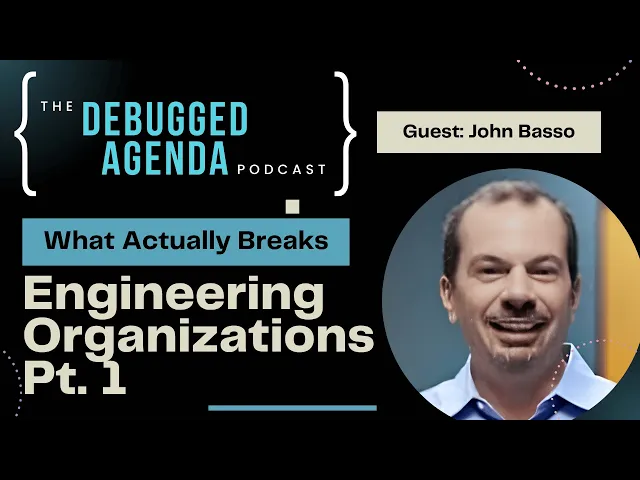
John Basso
What Actually Breaks Engineering Organizations
In the debut episode of The Debugged Agenda, host Jason Short sits down with John Basso, serial CTO, consultant, author, and CEO of Amazing Future, to unpack how AI is reshaping the modern engineering organization from the inside out.
The conversation moves from the engineering floor to the boardroom. Basso describes teams that have quietly become hybrids of humans and AI agents, where work is tagged, executed, reviewed, and QA'd across a mix of machine and human contributors. He contrasts the companies racing to integrate AI against those still "dipping a toe in," and argues the gap between them won't just be a performance gap. It will determine which companies stay in business.
Basso also draws on decades of technology adoption cycles, from Lotus Notes to cloud computing, to explain why this AI moment feels different: the pace of change has outrun the usual 10-year maturity curve, leaving leadership teams without a shared language to even discuss what's happening. He closes Part 1 with a breakdown of trust as the real differentiator between companies that transform smoothly and those that don't, and a candid look at how power actually works in a boardroom (hint: it's not always the person with the title).
Listen here




About the guest

John Basso
CTO
John Basso has built technology organizations from the ground up, then done it again and again. He serves as a CTO for multiple startups, leading engineering teams through early product development, rapid growth, technical debt cleanup, and the moments every founder eventually hits where the company needs to scale fast. John is an entrepreneur, a consultant, a published author, a black belt, and a snowboarder. He's currently the CEO of Amazing Future, and brings a rare vantage point to the conversation: he regularly advises private equity and venture capital firms on technical due diligence, giving him a front-row seat to how companies across industries are adapting to AI.
Full Breakdown
Key Takeaways
AI is forming hybrid human-agent teams. Some of Basso's clients now have agents writing code, other agents reviewing it, and humans making the final call, a structural shift in how work gets assigned and reviewed.
The adoption gap will separate winners from losers. Companies aggressively integrating AI versus those moving cautiously will see "dramatic consequences," including, in Basso's words, the difference between being in business and not being in business.
History repeats: new tech first mimics old process. Just as companies once digitized paper forms exactly as they were, most organizations are currently automating existing workflows rather than reimagining them. True transformation comes later.
Trust is the real catalyst for change. High-trust, high-performing teams adapt to disruption faster. Low-trust teams default to deferring to rank or credentials, which slows transformation when speed matters most.
Boardroom power often doesn't match the org chart. Founders, key individuals with leverage, or simply the most engaged voice in the room can hold more real authority than title alone would suggest.
AI economics break the old cost model. The shift from cheap laptops (because power lived in the cloud) to expensive local AI hardware and token spend is creating sticker shock that executives aren't yet prepared for.
The right question isn't "how do we finish," it's "how do we start." Every team and division needs its own entry point into AI adoption; there's no one-size-fits-all rollout.
Timeline
Time | Topic |
|---|---|
0:00 | Cold open: AI's coming impact on boardroom decisions |
0:32 | Welcome to The Debugged Agenda + guest introduction: John Basso |
1:53 | What Basso is working on now: AI's impact across his client base |
2:45 | Why AI adoption feels different from past tech cycles (no time for the usual 10-year maturity curve) |
5:02 | The rise of hybrid human-AI teams and how agile boards now tag AI-assigned work |
7:44 | How executives should start planning for AI adoption |
9:38 | The pattern of new tech mimicking old processes before true transformation happens |
13:15 | Story: the Lotus Notes era and how executives resisted early email adoption |
16:05 | Why the gap between AI-embracing and AI-cautious companies will have major consequences |
18:54 | The "you can't learn to swim from a book" philosophy on AI experimentation |
21:07 | Why every AI conversation today takes an hour just to establish shared language |
21:27 | The hidden cost shift: cloud economics vs. the new price of AI hardware and tokens |
23:15 | The one question every CTO/VP of Engineering should ask their CEO or board |
24:34 | Why trust is the key indicator of high-performing teams (and the Google research behind it) |
26:45 | Redefining "team" to include vendors and critical dependencies |
28:01 | How Basso builds trust before recommending organizational change |
31:11 | Boardroom power dynamics: rank vs. who actually holds influence |
34:00 | Reading a room: how to spot real authority versus leverage and ego |
37:18 | Close of Part 1 + setup for Part 2 |
References
Peter Drucker — referenced for early-20th-century foundational work in business process and organizational analysis
Google's team performance research — referenced regarding psychological safety and trust as predictors of high-performing teams
Agile "Form, Storm, Norm, Perform" model — referenced as a framework for team development stages
The Lord of the Rings (film reference) — used as an analogy for slow, indecisive deliberation in the face of urgent change
Lotus Notes / Arthur Andersen — referenced as a historical case study in enterprise technology adoption resistance