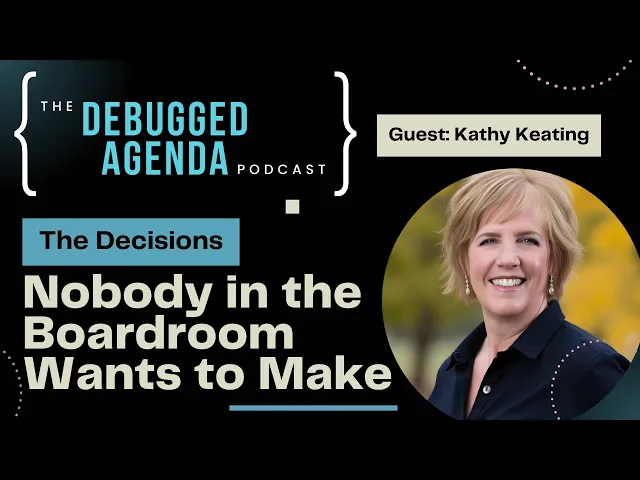
Kathy Keating
The Decisions Nobody in the Boardroom Wants to Make
Main Description
In this episode of The Debugged Agenda, the conversation opens with a live example: Keating recently used Claude as a full partner to design an enterprise service experience from the ground up, and walks through why service design, not AI tooling, is now the true competitive moat. From there, she and Jason examine the widening gap between what AI makes possible and what most executive teams are equipped to manage, including a pointed observation that most C-suites still have no shared operating system, no clear decision-making discipline, and no common language for talking about what technology actually delivers.
Listen here




About the guest

About the Guest
Kathy Keating is a Technology Advisor, Board Director, and CTO Executive Coach. She’s also the co-author of Liquid, a systems thinking framework built specifically for the C-suite.
Full Breakdown
Key Takeaways
Service design is the real moat in an AI world. As AI commoditizes software capabilities, how a company services its employees and customers becomes the primary differentiator. Keating is already using AI as a full partner to design and deliver those service experiences faster than ever.
The C-suite hasn't caught up to the design-first reality of AI development. AI produces better output when it receives better-designed inputs. But most executives still judge outcomes without valuing the quality of the written design going in, which means they're accelerating output without improving the thinking behind it.
Vibe coding is here whether engineering likes it or not. CEOs, CFOs, and CROs are going to build things themselves. The role of product and engineering is no longer to gatekeep code but to build the frameworks, standards, and systems within which democratized coding stays safe, scalable, and aligned.
The average CTO has about nine months to build trust before it’s already eroding. Research Keating cites puts average CTO tenure at 18 months, with trust breaking roughly nine months before the firing. If you’re not actively cultivating trust upward and outward from day one, you’re already behind.
CTOs get fired for speaking the wrong language upward. Technologists are fluent communicating downward to their teams. The failure point is almost always the translation upward: revenue, gross margin, EBITDA, speed to market. If the board can’t connect what you’re building to those outcomes, trust breaks.
Most C-suites don’t have a shared operating system. People leave executive meetings with different interpretations of what was decided, who owns it, and what happens next. Keating argues this dysfunction, not technical incompetence, is the most common root cause when leadership teams fail.
Systems thinking is the most undervalued skill in the C-suite. At a Techstars founder conference, Keating asked a room of 100 CEOs how many considered themselves systems thinkers. Two raised their hands. The ability to think four or five orders of change ahead and orchestrate across silos is what separates executive teams that can navigate AI from those that can’t.
Influence, not power, is what actually drives organizational change. Forcing compliance creates fragile organizations. Keating coaches leaders to build transparency, clear operating rhythms, and accountability structures so that change takes hold through habit rather than authority.
The daily personal retro is one of the highest-leverage habits a leader can build. What went well? What didn’t? What do I do differently tomorrow? Keating has run this practice every day for years and credits it as the foundation of her ability to hold herself and others accountable without finger-pointing.
Timeline
Time | Topic |
|---|---|
0:00 | Cold open: no one in the C-suite knows how to make a decision or even recognize when they’re making one |
0:07 | Welcome to The Debugged Agenda |
0:53 | Guest introduction: Kathy Keating |
1:00 | What Keating is working on now: AI-enabled service design for a large enterprise |
2:19 | The divide between AI-mandating companies and those still dipping a toe in |
2:53 | Why AI development requires written design, and why the C-suite hasn’t caught up to that reality |
5:01 | How TDD and design documentation connect to AI output quality |
5:35 | Using diagrams, Figma, and Claude as a design and documentation partner |
6:52 | The democratization of front-end development and why the systems designer role is now more critical |
7:44 | User acceptance testing vs. feature velocity: can customers absorb what AI lets you ship? |
8:24 | Historical parallel: the late-80s accounting tech wave and what it did to workforce size |
9:30 | Keating’s coaching focus: alignment first, intention over reactivity |
10:22 | The vibe-coded CEO story: trust broken in one weekend, what happens Monday morning |
11:24 | The new role of product and engineering in a world where coding is democratized |
13:41 | The “shiny red ball” problem: how CEOs bring back ideas from trade shows and what to do with them |
15:08 | Trust as the sandbox: building frameworks that let executives experiment safely |
17:06 | The most common reason CTOs get brought in and fired: lack of trust |
18:01 | Average CTO tenure is 18 months; trust has been breaking for nine months before the exit |
19:43 | If you’ve had five CTOs and it’s still not working, the problem isn’t the CTOs |
20:32 | Why CTOs fail to communicate upward: speaking tech to a board that only wants business outcomes |
21:51 | What aspiring CTOs and senior engineers should start practicing now |
23:38 | The three bricklayers parable: brick vs. building vs. shelter for the homeless |
25:08 | Where does problem-solving get taught? The junior engineer pipeline and the AI cannibalization risk |
27:14 | The acceleration gap: companies committing to AI now vs. those still dipping in, in six months |
28:33 | One company’s engineers capped at $10 of AI credits per month |
29:00 | The “Liquid” framework: boiling vs. frozen vs. flow as an organizational state |
30:03 | The Techstars moment: 100 CEOs, two systems thinkers |
30:24 | What it actually means to not know you’re making a decision: the white-labeling example |
34:03 | Why the CEO’s job is harder and more important in an AI-speed world |
34:16 | Systems thinking explained: bubbles, boundaries, gaps between subsystems |
36:10 | Complex adaptive systems: change has ripple effects; you have to think four orders ahead |
38:39 | Influence vs. power as a leadership technique, and why power-driven organizations are fragile |
39:41 | Practical techniques for teaching influence: transparency, operating systems, OKRs, EOS |
42:17 | One practical thing for teams: end every discussion by capturing actions, owners, and cadence |
43:08 | One practical thing for individuals: the daily personal retro |
45:55 | Book overview: Liquid (co-authored with Etienne de Bruin and Scott Graves) and the CTO Levels framework |
48:16 | Rapid fire round: favorite tool, most overrated trend, changed leadership belief, best unsung CTO skill, morning ritual |
50:55 | Closing: where to find Kathy Keating |
References
Liquid: How CEOs & CTOs Unlock Momentum in Complex Systems (Kathy Keating, Etienne de Bruin, Scott Graves) – co-authored by the guest; framework discussed throughout the episode
CTO Levels – co-created framework that codifies the CTO role across different company sizes and stages (ctolevels.com)
Thinking in Systems (Donella Meadows) – referenced as one of the foundational systems thinking books that preceded Liquid
The three bricklayers parable – referenced by Jason as a framework for communicating purpose at different levels of abstraction
Reclaim.ai – named as Keating’s go-to tool in the rapid fire round (AI-powered calendar management)
OKRs, EOS, Shape Up – referenced as examples of business operating system frameworks for executive team clarity
Figma – referenced as a design tool used alongside Claude to accelerate service design workflow
Claude (Anthropic) – referenced by Keating as her primary AI partner for service design, stakeholder synthesis, and diagram generation
Personal Software Process – referenced by Jason as an early career practice for disciplined software estimation