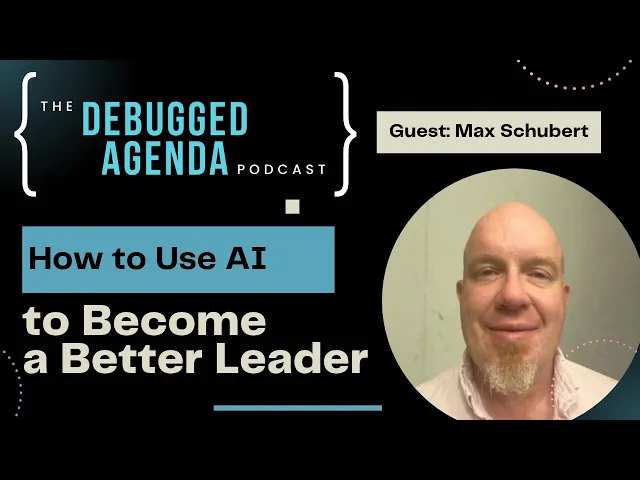
Max Schubert
How to Use AI to Become a Better Leader (EQ, Feedback & Hard Conversations)
Listen here




About the guest

About the Guest
Max Schubert is a Senior Director of Engineering at Teachstone, where he leads security alongside SRE and data engineering teams. His work spans applied AI, systems thinking, AI governance and safety, cybersecurity, and building high-impact engineering organizations.
Before moving into engineering leadership, Max built his career as a senior software developer, consultant, and lead systems engineer. He is a daily practitioner of AI as a coaching tool and an advocate for using it to make people more capable, with emotional intelligence at the center of how he leads.
🔗 Learn more about CH2 Solutions: https://ch2solutions.com
Full Breakdown
Key Takeaways
AI works best as an exoskeleton. Max frames AI as a tool that gives people new strengths. Keep the same staff count and aim for 1.5x the output and the quality, with a coach and mentor at every person's fingertips.
Rehearse the hard conversations. Max uses ChatGPT to check his written responses and run practice sessions before high-stakes client meetings and coaching one-on-ones, so his live thinking matches his best asynchronous thinking.
Ask the AI to explain itself and critique you. Have it tell you why it made each change and build critique into your base instructions. The feedback loop turns every edit into a lesson and makes critique feel normal.
Don't let AI become a crutch. When team members shipped AI-generated work they couldn't explain, it broke down. If AI produces something you don't understand, have it teach you.
Overexplain your context. Rich, detailed prompts produce grounded output. Sparse, vague prompts can produce answers disconnected from reality.
Specific feedback is the feedback that sticks. "Great job" means little. Name what happened and why it mattered, and people know what to repeat. For negative feedback: actionable, specific, and kind.
Leaders model behavior whether they intend to or not. In any group setting, people are watching. Specific, thoughtful communication raises the EQ of the whole room, including the boardroom.
Contractors work best when they stay long enough to connect. In a complex, legacy ecosystem, short one-off contracts turned in-house engineers into quality gates. Staff augmentation of three to six months or longer lets contractors become independently productive.
Time zone proximity builds trust. Nearshore engineers working in overlapping daylight hours make it easier to connect as people and handle difficult conversations at the right time.
Timeline: Main Topics
Time | Topic |
|---|---|
0:00 | Cold open: keep the staff, raise the quality |
0:20 | Welcome to The Debugged Agenda and episode introduction |
2:48 | Max joins: AI, psychology, and becoming a better communicator |
3:12 | How Max started using ChatGPT as an emotional intelligence coach |
5:27 | Security questionnaires and rehearsing high-stakes client conversations |
7:30 | Preparing for difficult coaching one-on-ones with voice mode |
8:21 | Learning Spanish, Russian, and Hungarian with AI |
10:12 | AI as an exoskeleton: augmenting people instead of replacing them |
11:24 | EQ classes vs. AI coaching, and the risk of AI as a crutch |
13:02 | Learning from AI edits and asking for critique every day |
15:10 | Picking up constructive language and the habit of saying thank you |
16:17 | Sponsor message: CH2 Solutions |
16:48 | Why Max overexplains context when prompting |
18:05 | Setting context in one-on-ones and giving specific feedback |
21:25 | How specific communication raises the EQ of the room |
23:10 | Using AI to build presentations and talking points in your own voice |
25:27 | Full-time employees vs. contractors: budgeting and flexibility |
28:52 | Why one-off contracts struggled in a legacy codebase |
30:11 | Team extension, nearshore engineers, and time zone proximity |
31:49 | Rapid fire: tools, AGI, EQ, and morning rituals |
33:38 | Closing thoughts |
References
ChatGPT (OpenAI): Max's primary tool for EQ coaching, conversation rehearsal, voice mode practice, language learning, and presentation prep.
Claude (Anthropic): Mentioned by Max as another source of constructive feedback.
Amazon Nova via Alexa: Used by Max for spoken conversations that help him practice expressing ideas out loud.
Duolingo: Language learning app referenced for its added AI capabilities.
Existentialism: Max's takeaway from college philosophy: your actions affect the world even when you think no one is watching.
Staff augmentation and team extension: The contractor model Max and Jason recommend for complex software ecosystems.